The Fire, the Threshold, and What Comes After
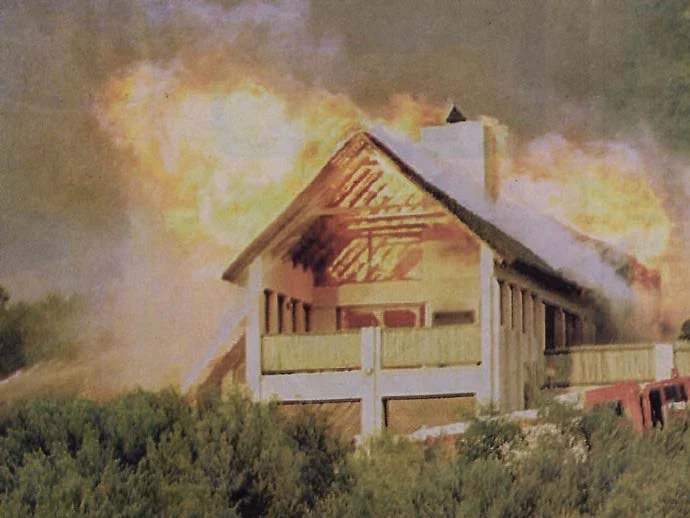
It was May 2005. I heard my wife, Julie, scream. I ran upstairs and found a roaring flame erupting out of the gas heater in our bedroom. I heard myself say, “The house is going to burn down. Get out now!”
I ran to my study for my laptop, looked for our dog, and shot downstairs to make sure Julie was safe. When I saw that both she and the dog were out, I tried to go back upstairs. But, by then, the heat and flames were already too fierce. Within half an hour, the house had burned to the ground. Only the contents of the garage remained.
At the time, I was in the midst of a very demanding training as an African Traditional Healer, and money was very tight. We had cut back on almost everything, including contents insurance. So, the losses were immense. Our photographs and family memorabilia were gone. My library of thousands of books, including rare editions, was destroyed. Precious inherited objects were reduced to ash. Even small sacred things that had carried deep meaning for me disappeared in the fire.
It felt catastrophic.
That evening, standing on a neighbour’s balcony and looking at the blackened remains of what had been our home, I knew in a flash that my marriage was over. Not because Julie was a bad person. Quite the opposite. She is warm, kind, and deeply good. But something in me knew, with a certainty I could not argue with, that this part of my life had ended.
To say that it was awful would be an understatement.
At first, I was simply in shock, functioning on adrenaline and survival instinct. But as the days passed and I began to reflect. It seemed impossible not to wonder at the name of the final initiation in my healer training: the Fire Ceremony.
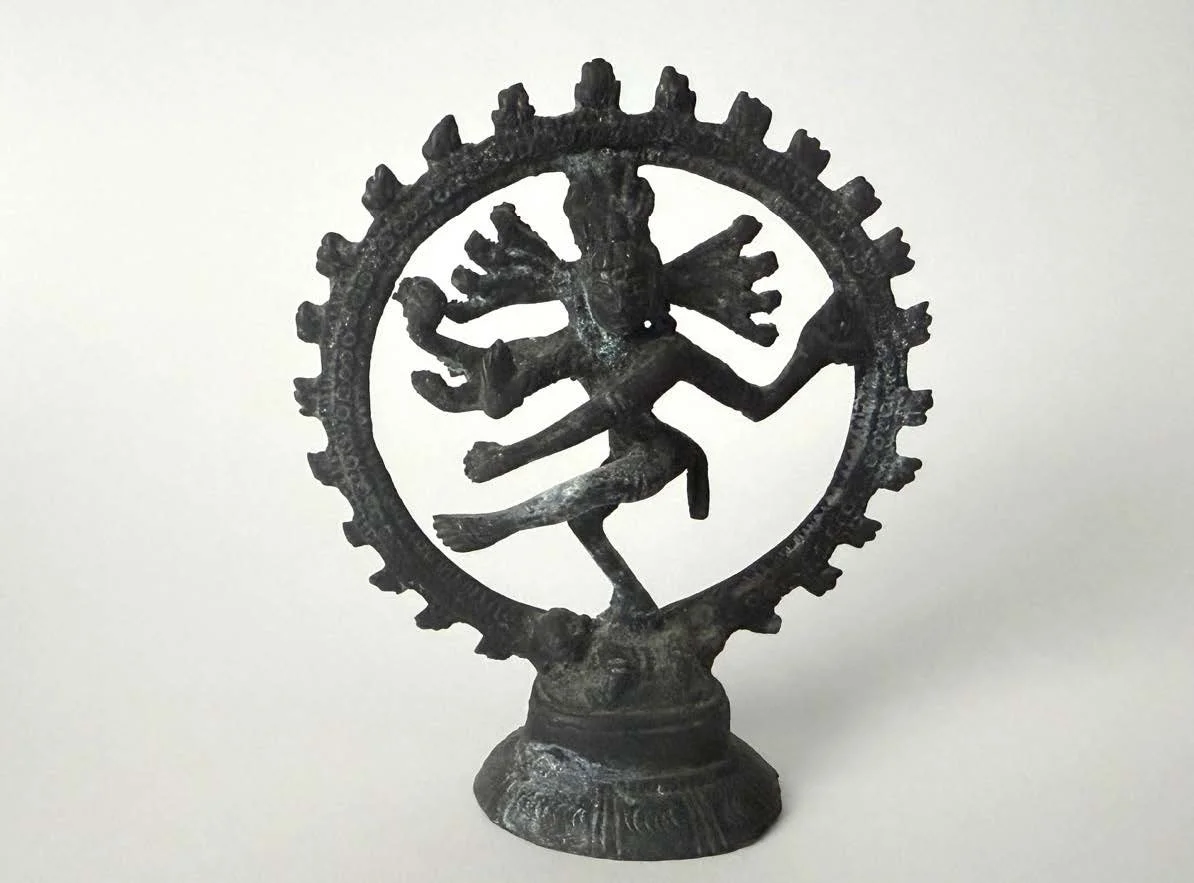
I was struck, too, by another fact. After the fire, the only object left standing in the ruined house was a statue of Shiva Nataraja. Now, I am not a Hindu, but the symbolism was hard to ignore. Shiva Nataraja is the image of the divine dancer within the circle of fire: creation and destruction, ending and beginning, death and renewal, all held within one movement.
The Shiva Nataraja that survived the fire
I had been thrown into a major transition.
The old life had gone. But what was to come in its place was not yet visible.
Now, all of us who are elders know that one of the hardest things about such transitions is that the destruction is obvious, but the new life is not.
One is left in an in-between place: stripped back, uncertain, disoriented, searching for a way to live that has not yet taken shape. The old identity no longer fits, but the new one has not yet formed. We feel lost in a liminal space.
Fortunately, I already had a grounding in Buddhist teaching, and the understanding of impermanence was a real support. Everything changes. Everything passes. However painful the loss, nothing in life is fixed.
I was also familiar with the Medicine Wheel as taught to me by Stephen Foster and Meredith Little. Like the circle of fire around Shiva, it speaks to a reality that modern culture often forgets: life is not linear. It moves in cycles. There are seasons of emergence, flourishing, decline, death, and renewal. Endings are not mistakes in the process. They are part of the process.
These teachings did not make things easy.
But they did provide a context.
I would never have chosen the deep transition that the fire forced me into. It dismantled structures, identities, and attachments that I had assumed would continue. It threw me into grief, confusion, and uncertainty.
Over time, however, I came to understand that part of the message was that the path of the African Traditional Healer was not to be my path. This was extraordinarily difficult to absorb. I had invested deeply in that training and endured initiations that were anything but superficial. To walk away from it felt unthinkable. And yet, slowly, painfully, I came to see that I had to.
I had to walk into the unknown. Today. I am deeply grateful that it happened.
Many of us who are moving into elderhood are dealing with our own transitions: losses of role, certainty, health, energy, identity, relationship, future assumptions. But we are also living at a time when the wider world is in transition. Old structures are fraying. Shared certainties are breaking down. The future is unclear. It is entirely natural that many people feel frightened, ungrounded, or overwhelmed.
But it matters how we understand what is happening.
If we do not see these times as a transition, we are very likely to fall into blame. We look for individuals, groups, or nations to hold responsible for the fact that the world no longer feels stable. We regress psychologically. There must be a villain. There must be someone to punish. We look backward with longing, idealising a past that was never as coherent as we now imagine it to have been.
That unconsciously driven way of meeting collective uncertainty only deepens insecurity as well as a sense of hatred.
To see our current moment as a transition is not to become passive, nor to deny injustice or danger. It is to recognise that we are living through a profound unravelling of old forms, and that this inevitably generates fear, grief, disorientation, and struggle. Joanna Macy, author of Active Hope, used the phrase “The Great Unravelling” to describe this phase and also pointed toward the possibility of a “Great Turning”: a difficult, uncertain movement toward a more life-sustaining civilisation.
Whether that outcome happens is not guaranteed.
But it certainly becomes less likely when fear drives us into tribalism, reactivity, and blame.
Another dimension of the Shiva symbolism is pertinent. Shiva dances on a dwarf representing ignorance. In psychological terms, one might say that liberation depends in part on seeing through the distortions of ego: fear, inflation, projection, certainty, and self-righteousness. We all know how easily threat pulls us into these states.
This is why inner work matters so much in times like these.
Perhaps one of the tasks of elderhood is precisely this: not to deny fear, but to metabolise it sufficiently that it does not rule us. In this process, we recognise that we need our threat systems; they are part of how human beings survive. But we know that we also need our capacities for reflection, relatedness, compassion, and perspective. Without those, fear quickly turns into othering, and othering into conflict.
That is no small thing.
As elders, or as those growing into elderhood, we may not be able to fix the world. But we can help to hold a steadier, wiser position within it. We can remember that breakdown and renewal are often intertwined. We can resist the pull toward simplistic blame. We can bring a longer view. We can model the capacity to stay in relationship, to remain reflective under pressure, and to trust that the collapse of one form does not mean the end of life.We can hold steady to the understanding that something else is trying to be born.
Bill Petrie is a psychologist and mentor working online with professionals and founders in midlife transition. Find out more about his work.
This article written by Bill was published by the Centre for Conscious Eldering in Durango, USA, Spring 2026